2026 CTV Fragmentation Report for App Teams
Map connected-TV fragmentation by runtime, package, device cohort and release owner instead of relying on incomparable household totals. Practical guidance.
A connected-TV roadmap gets slippery as soon as somebody asks for one coverage number. Google reports device activity, Roku reports households and a television manufacturer may describe annual model groups. Those figures answer different business questions, and none of them tells an app team how many runtimes, packages, stores or test cohorts it must own.
For engineers, connected TV fragmentation is an operating problem. The useful unit isn't a logo. It's a release track: one runtime, one package format, one store path, a defined device cohort and a named owner. This report maps that work without turning incompatible public figures into a made-up market-share table.
The public reach numbers don't share a denominator
In May 2026, Google said the combined Google TV and Android TV OS ecosystem had more than 300 million monthly active devices. Roku's developer site says its platform reaches 100 million streaming households. Device activity and households aren't interchangeable. They also don't tell you which models run your codec, survive your memory profile or pass your current package.
| Public signal | What it can support | What it can't support |
|---|---|---|
| Monthly active devices | Ecosystem scale and activity | Unique households or your app reach |
| Streaming households | Household footprint | Active device count or model mix |
| Model-year catalog | Hardware and runtime planning | Installed-base share |
| Store availability | Distribution eligibility | Playback quality or support cost |
| Your app telemetry | Actual audience by app version | Prospective users who never installed |
The honest coverage model joins public platform facts with your own install, playback and support data. If those internal rows don't exist yet, call the forecast a forecast.
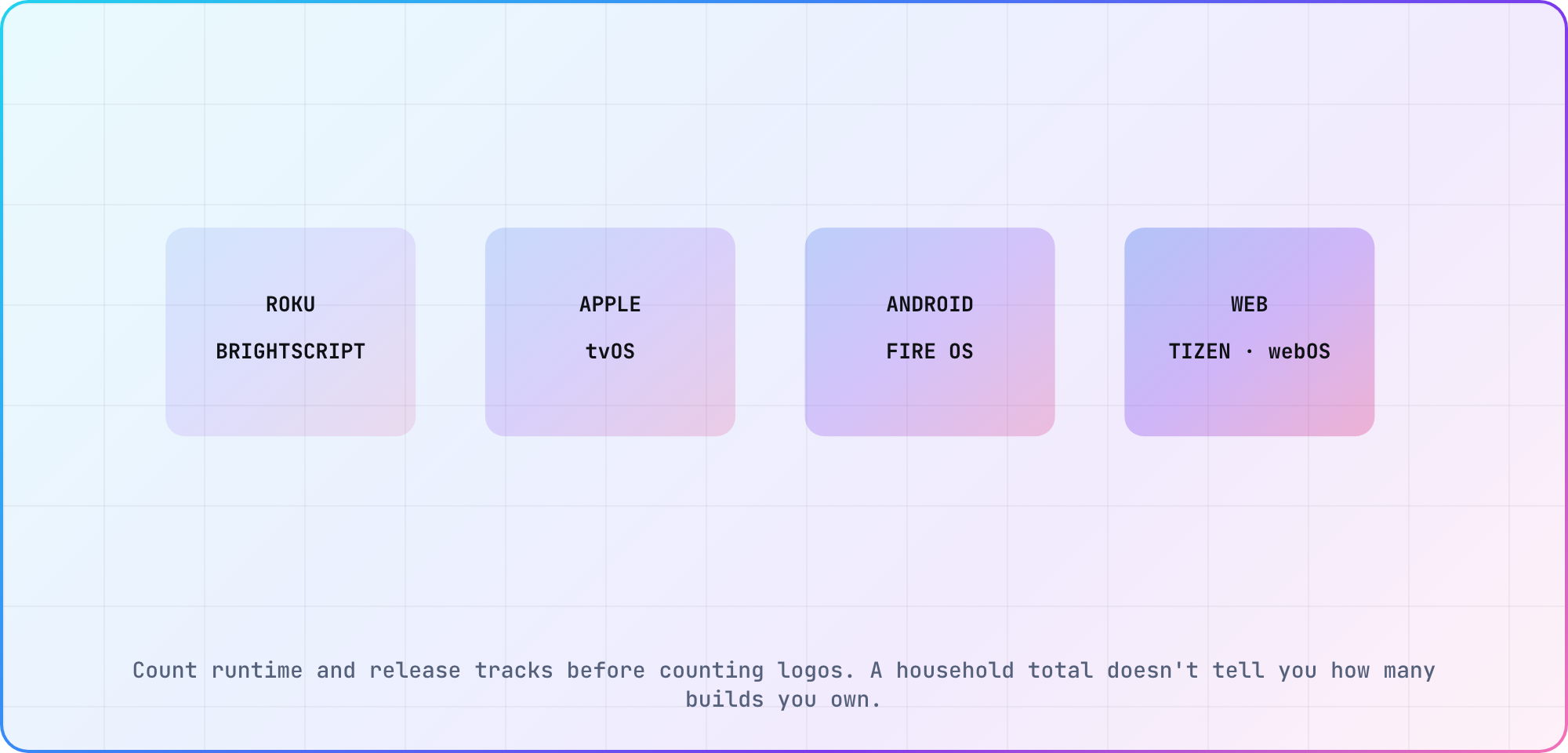
Count runtime and release tracks before counting logos. A household total doesn't tell you how many builds you own.
Count runtime families before platform brands
Roku uses BrightScript and SceneGraph. Apple TV uses tvOS. Google TV and Android TV share Android TV OS, while Amazon now spans Android-based Fire OS devices and its newer Vega path. Samsung Tizen and LG webOS both run web apps, but they don't share one package, store or device matrix. Neither is web-only: Samsung also documents Tizen .NET apps, and LG supports Flutter on webOS TV 26 Re:New and later.
That is at least four major engineering families before store work enters the picture: Roku, Apple native, Android-family, and embedded web. Amazon can add another release track when Vega devices are in scope. A shared service layer helps; it doesn't erase focus behavior, player integration, lifecycle events or certification.
Use the TV platform reference to normalize platform and version names. Then write the supported cohort next to each one. "Samsung" is too broad; a model group and year range is actionable. Samsung's own model-group reference is a better boundary than a brand checkbox.
Build a support ledger the release team can use
Start one row per release track. Add the oldest supported device, one common mid-range device and a current model. Record the runtime, package, store, player, DRM path and owner. The ledger should answer who investigates a black screen on an older set and which build produced the result.
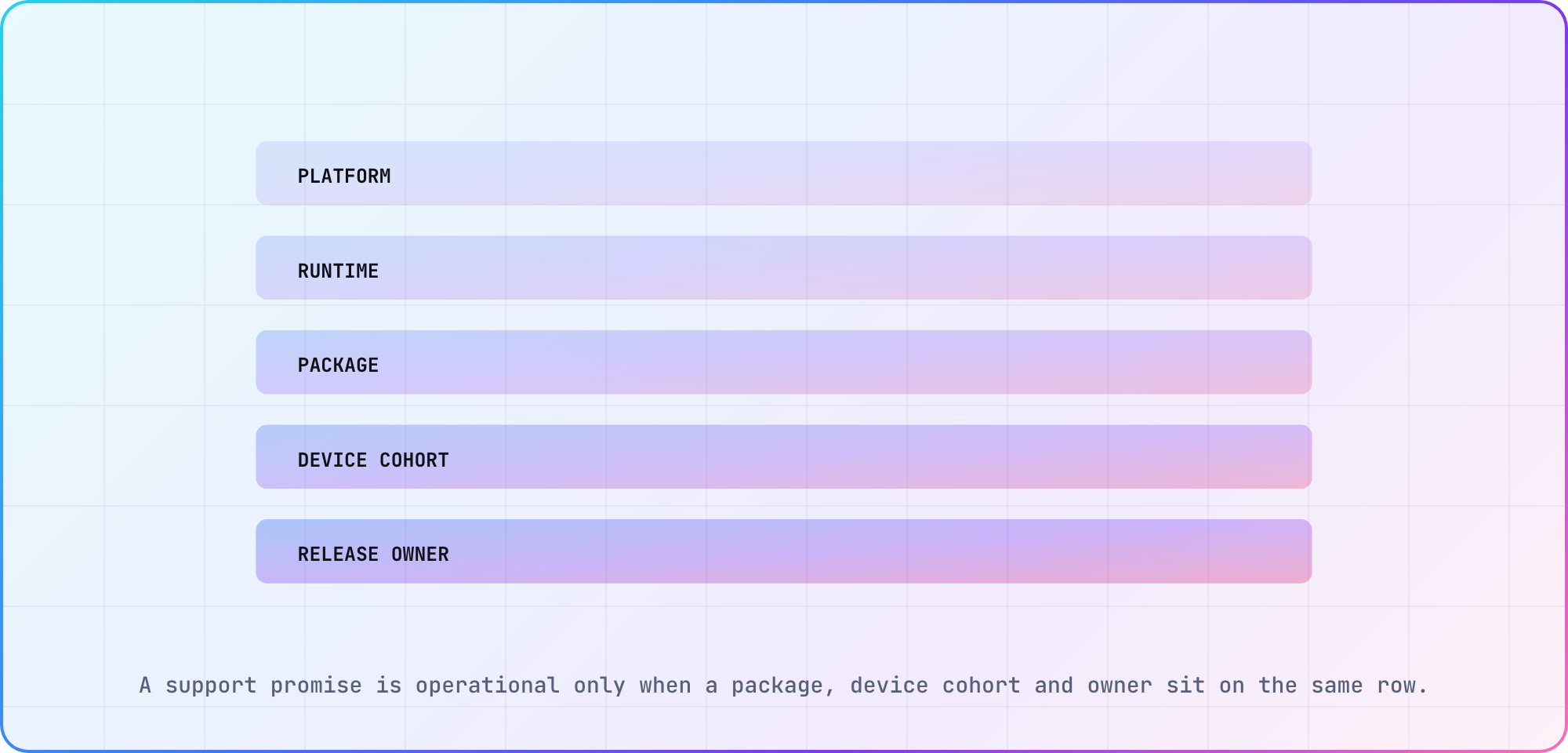
A support promise is operational only when a package, device cohort and owner sit on the same row.
I'd keep audience estimates out of this ledger. Reach belongs in prioritization; release evidence belongs here. Mixing them tends to turn a commercial assumption into a technical promise.
Use fragmentation to sequence work
The first launch should buy information for the second. If Android TV OS reaches a large part of your known audience, it can prove the Android player and remote model. That evidence won't certify Roku or tvOS, but it may prove backend contracts, analytics events and content rules. A web-TV launch can then expose older browser and memory constraints before a second web store reuses the shell.
Before adding a platform, ask what new runtime, playback path, store gate and support burden it introduces. The CTV release-readiness checklist is useful here because it forces the package and evidence work into the estimate.
What this report deliberately doesn't claim
There is no defensible universal statement that three platforms equal 80% of every service's audience. Geography, distribution deals, existing subscribers and content rights change the answer. Public platform totals are useful context. Your entitlement, install and playback data should decide the support matrix.
The practical output is a dated ledger, not a pie chart. Review it when a platform adds a runtime, a store changes its criteria, or support data shows a cohort costs more than it reaches.
Frequently asked
How many CTV platforms does one streaming app need?
There isn't a universal count. Start with the platforms used by your reachable audience, then price each additional runtime, store and device cohort. A smaller list with named owners and hardware evidence is a stronger launch plan than a broad logo list whose oldest supported device nobody can identify.
Is Google TV a separate application platform from Android TV?
Google TV is an experience built on Android TV OS, so a properly built Android TV application runs on Google TV devices. The launcher, recommendations and discovery surface can differ, which creates product and test work, but it doesn't require a separate application codebase by default.
Can public device totals be combined into market share?
Not cleanly. Public figures may count monthly active devices, households, shipments or store reach. Adding them produces a precise-looking number with mixed denominators and overlapping homes. Use each figure in its stated scope, and use your own installs and playback sessions for platform prioritization.
What belongs in a CTV device cohort?
A useful cohort names platform, model family or year, OS or firmware, application version, player path, codec and DRM where relevant. Add the expected remote and network conditions. That row is specific enough to reproduce a failure and broad enough to assign support ownership.
Does a shared codebase remove CTV fragmentation?
It reduces duplicated product logic, but focus, lifecycle, playback, package signing, store review and hardware behavior still diverge. Treat shared code as one layer in the plan. Keep platform-owned work visible so the first certification failure doesn't arrive as an unbudgeted surprise.
How often should the support matrix be reviewed?
Review it at least around each major release and whenever a platform changes runtimes, store criteria or supported model groups. Also revisit it when telemetry shows a growing crash cohort or support queue. The matrix is an operating record, so stale ownership is as risky as stale device data.
Keep reading
Remote Smart TV Testing Without a Local Device Lab
Compare remote smart TV testing by exact hardware coverage, interaction depth, private-network access and evidence capture, then keep a small local smoke kit.
Samsung Tizen TV Test Automation: Limits and Workarounds
Automate Samsung TV build, signing, install and evidence capture while keeping device focus and playback verdicts outside unsupported official UI automation.