Native vs Cross-Platform CTV Apps: Honest Tradeoffs
Choose native or cross-platform CTV architecture by mapping shareable contracts and keeping focus, playback, lifecycle and store work owned by each runtime.
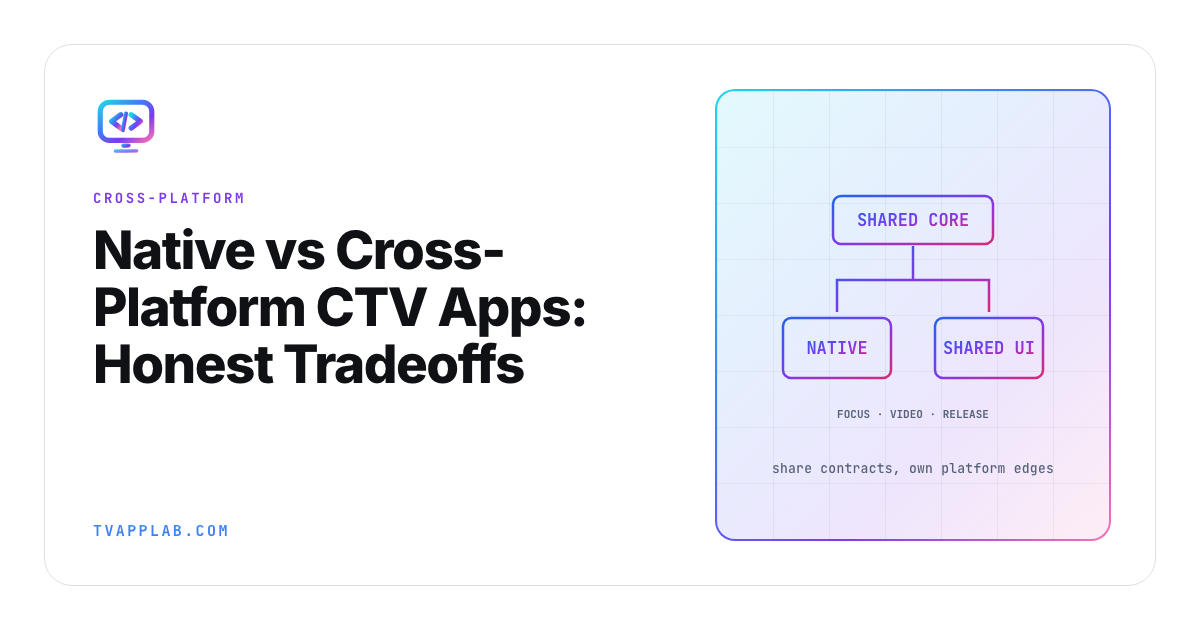
A cross-platform TV pitch often starts with a percentage of shared code. I'd ask a different question: which bugs will still need someone who understands the target television? Focus, playback, lifecycle and release work tend to answer that quickly.
Native vs cross-platform CTV apps is a boundary decision, not a vote for one framework. The React Native TV maintained fork targets Apple TV and Android TV. Samsung Tizen and LG webOS run web apps with their own TV APIs, and both vendors now document Flutter for newer models too. Roku remains BrightScript and SceneGraph. A shared product can span them, but a single runtime doesn't.
Map the runtime before choosing the framework
Write every launch target and its supported package format, UI framework, player and store. Don't collapse "Fire TV" into one row now that Amazon documents Fire OS and Vega OS separately.
| Target family | Typical UI/runtime | Shareable layer to consider | Platform-owned edge |
|---|---|---|---|
| Apple TV | SwiftUI/UIKit or React Native TV | Models, services, design tokens | Focus engine, AV playback, App Store |
| Android TV / Fire OS | Compose/views or React Native TV | Kotlin/JS product logic, services | D-pad, Media3, Play/Amazon release |
| Samsung Tizen / LG webOS | Web application, or vendor Flutter (Tizen 6.0+, webOS TV 26+) | TypeScript business logic and web UI pieces | TV APIs, player, model support, seller portals |
| Roku | BrightScript and SceneGraph | API contracts, analytics schema, assets | UI, player, packaging and certification |
| Vega OS | React Native for Vega (Amazon's SDK) | JS/TS contracts and selected components | VPKG, runtime APIs and targeting |
The table shows why "cross-platform" has several meanings. A team might share TypeScript models across web TVs, React components across Apple and Android TV, and only backend contracts with Roku.
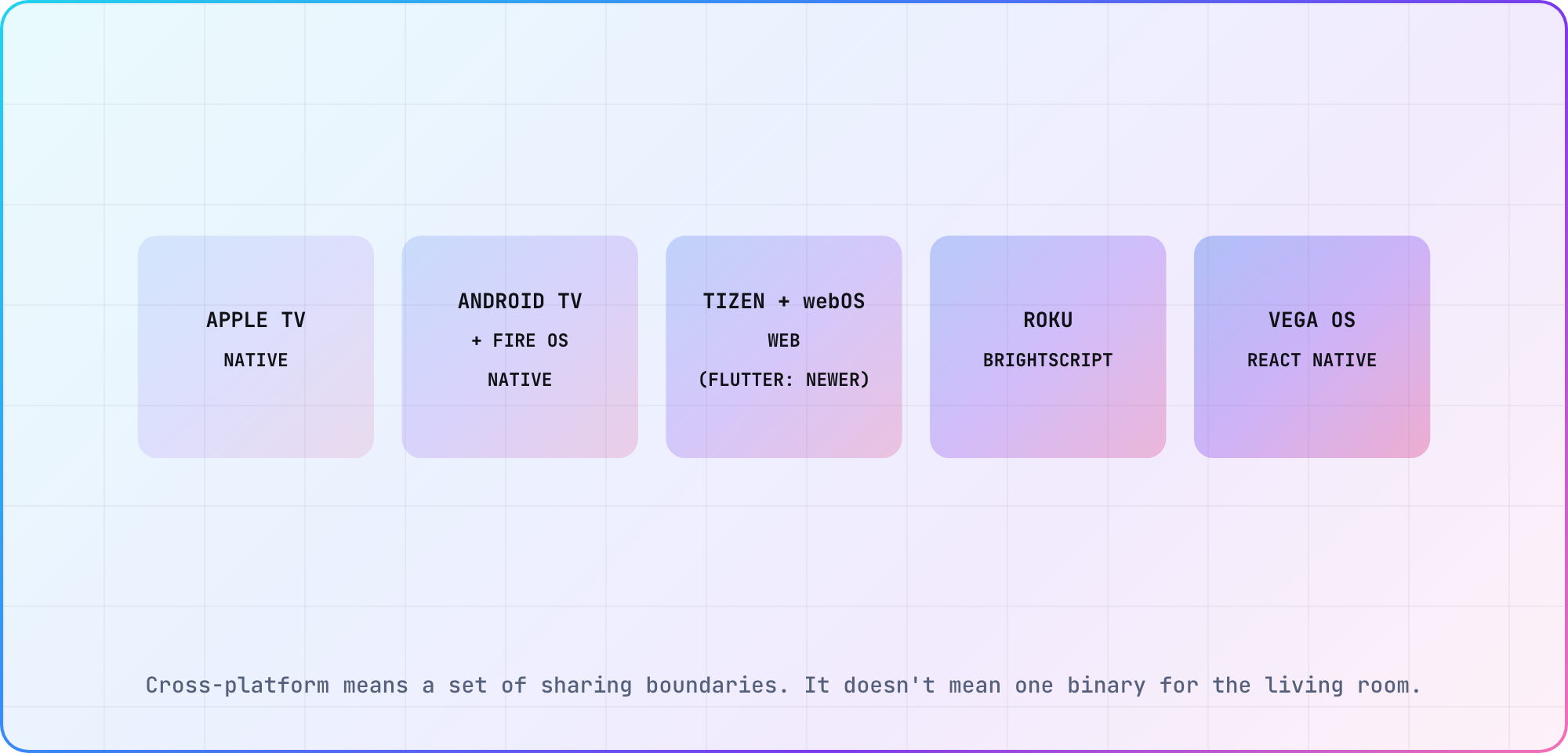
Illustrative runtime map based on the current documented target families.
Share stable contracts first
API clients, data models, analytics event names, feature flags, content fixtures and design tokens usually travel better than remote interaction or playback. They also fail in easier-to-diagnose ways.
Define the shared boundary with platform-neutral tests. A catalog parser can accept the same fixture everywhere. An entitlement state machine can emit the same states. The UI layer can then translate those states into native focus and player behavior.
The React Native TV guide documents the maintained Apple TV and Android TV fork. Use its actual support matrix, not the broader mobile React Native brand, when estimating coverage.
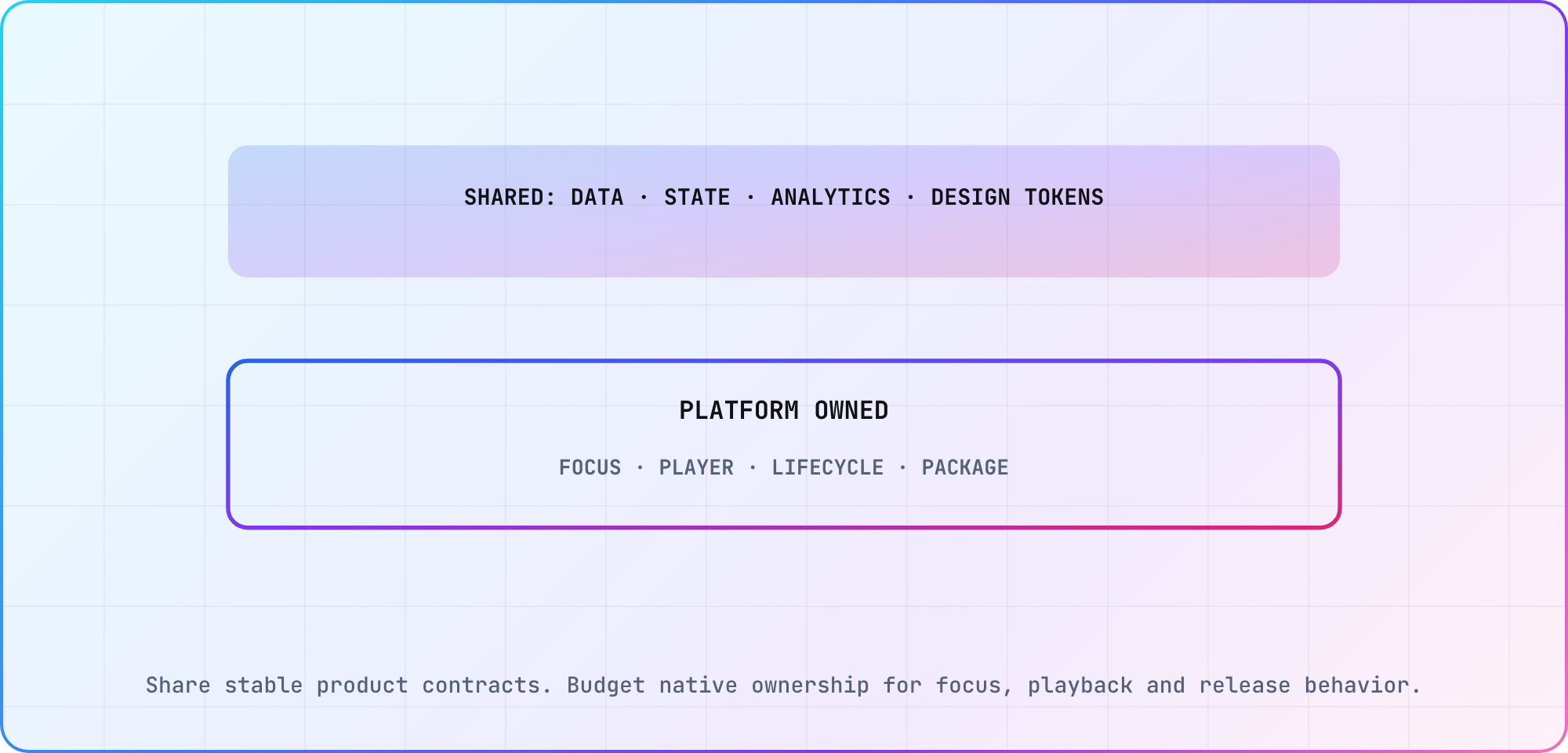
Illustrative architecture boundary. Move a layer upward only after two target implementations prove it stable.
Price the platform edges honestly
Focus is the first edge. Android, tvOS and browser-based TVs all support directional interaction, but their eligibility, restoration and event models differ. A shared component abstraction can help, while a universal focus manager often leaks platform behavior through flags.
Playback is the second edge. Player APIs, DRM, ads, audio tracks, captions and lifecycle callbacks differ. Keep a common playback state vocabulary if it helps analytics and product logic, then let each target own the player integration and error translation.
Release work is the third edge. One repository doesn't create one package or one review. Every store needs assets, account ownership, reviewer access, target-device proof and a rollout record.
Use a spike to test the architecture
Build the same narrow journey on two different target families: browse, details, playback and Back. Include protected content if DRM is a launch requirement. Record which files, tests and bug fixes were truly shared.
Measure more than code percentage:
- time to first target-device playback
- platform-specific lines and configuration
- focus defects and player defects
- build and signing complexity
- time to diagnose one intentional failure
- store-ready artifact ownership
A framework can reduce feature work and still increase release or debugging time. The spike should expose that trade before the full catalog arrives.
Choose ownership, then choose tools
Native is a good fit when one or two platforms dominate, player or UI requirements are deep and the team can own those stacks. A cross-platform layer is attractive when several targets share product behavior and the team accepts native escape hatches. A hybrid architecture is common because CTV itself is a collection of runtimes.
My recommendation is to share contracts and business logic by default, then earn UI sharing one target pair at a time. If you do nothing, the architecture tends to follow the first demo, and the difficult focus or playback work appears later as "exceptions" that nobody staffed.
Frequently asked
Can one framework build every CTV app?
No current mainstream framework produces one supported application for Apple TV, Android TV, Fire OS, Vega, Samsung Tizen, LG webOS and Roku. You can share product contracts and selected UI layers across groups. Keep a runtime map so platform-specific focus, player, package and store work stays visible.
Which platforms does React Native TV support?
The maintained react-native-tvos project targets Apple TV and Android TV families. Check the exact Fire OS device when planning Amazon coverage; Vega OS uses Amazon's own React Native for Vega SDK instead. The fork doesn't turn Roku, Tizen or webOS into React Native targets, so those still need separate runtime decisions.
What code is safest to share across TV platforms?
API contracts, data models, analytics schemas, feature flags, content fixtures and design tokens are strong starting points. Pure business logic can follow when platform dependencies stay outside it. Focus, playback, lifecycle and release code deserve separate ownership until real implementations show a stable common interface.
Is native always better for video playback?
Native access can expose the platform player directly, but "better" depends on the service's codecs, DRM, ads, observability and team skill. Test the required media journey on target hardware. A cross-platform UI with a native player bridge can be a sensible architecture when responsibilities stay clear.
How should we compare native and cross-platform cost?
Measure time to playback, defects, diagnosis time, platform-specific code, release work and ongoing upgrades across a real two-target spike. Shared-code percentage alone misses focus bugs, player bridges and store operations. Include support and on-call ownership because the architecture continues costing money after the first launch.
When should a shared abstraction be removed?
Remove or narrow it when platform flags outnumber the stable behavior, errors lose useful detail or engineers must understand both the abstraction and native implementation for every fix. Preserve the shared contract if it still helps. The goal is a clear ownership boundary rather than the highest possible reuse number.
Keep reading
Remote Smart TV Testing Without a Local Device Lab
Compare remote smart TV testing by exact hardware coverage, interaction depth, private-network access and evidence capture, then keep a small local smoke kit.
Samsung Tizen TV Test Automation: Limits and Workarounds
Automate Samsung TV build, signing, install and evidence capture while keeping device focus and playback verdicts outside unsupported official UI automation.