Roku vs Fire TV vs Apple TV for Developers
Compare Roku, Fire TV and Apple TV by runtime, media integration, package, store process, hardware evidence and long-term release ownership. Practical.
Roku, Fire TV and Apple TV can all put a streaming service on a television. That is about where the engineering similarity ends. Roku has its own BrightScript and SceneGraph runtime. Apple TV is a tvOS target. Fire TV spans Android-based devices and Amazon's newer Vega direction.
A useful Roku vs Fire TV vs Apple TV comparison should expose the release systems your team will own. Syntax matters for hiring. Playback, device evidence, packaging, store review and ongoing support usually matter more to the budget.
Compare the runtime and release path
Roku's developer overview centers BrightScript and SceneGraph. Apple's tvOS portal centers its native platform and tools. Amazon's Fire TV documentation describes Fire OS as a fork of the Android Open Source Project and lists six versions, from Fire OS 5 (Android 5.1) to Fire OS 16 (Android 15 and 16). Vega OS devices take a separate VPKG binary, so one Android package doesn't automatically cover the roadmap.
| Area | Roku | Fire TV | Apple TV |
|---|---|---|---|
| Primary runtime | BrightScript and SceneGraph | Fire OS Android path; Vega on relevant devices | tvOS with Swift or Objective-C |
| Package track | Roku package | APK or Vega package by target | tvOS app archive |
| UI model | Scene graph and Roku components | Android TV UI or Vega stack | UIKit or SwiftUI with tvOS focus |
| Media work | Roku player and platform APIs | Android/Amazon or Vega media path | AVPlayer and Apple media frameworks |
| Device proof | Roku models and OS versions | Fire TV models, OS and runtime | Apple TV generations and tvOS |
| Store owner | Roku developer ecosystem | Amazon Developer Console | App Store Connect |
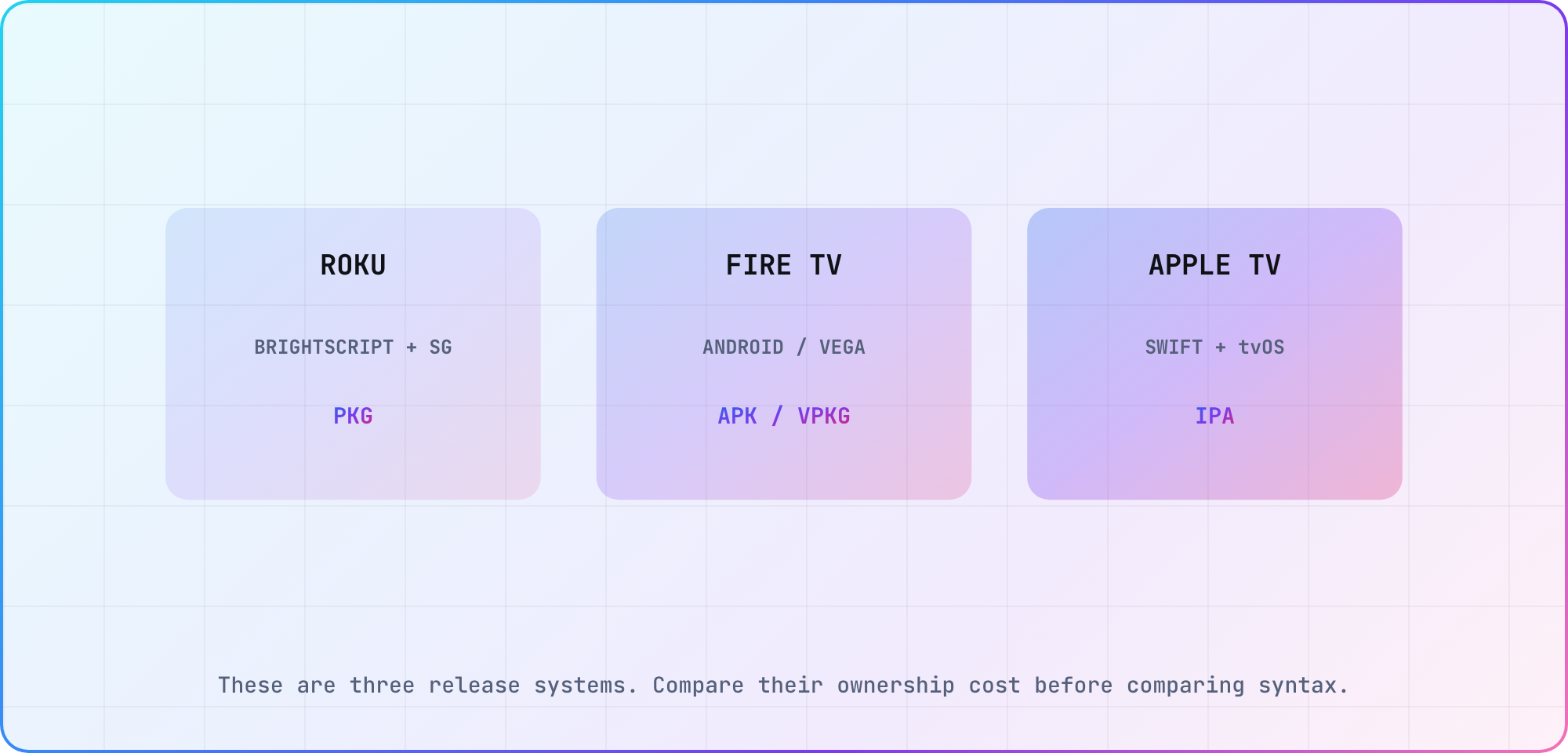
These are three release systems. Compare their ownership cost before comparing syntax.
Roku creates a distinct engineering track
Roku doesn't share a runtime with a web, Android or iOS application. You can share service contracts, catalog rules, analytics names and design intent, but the UI, focus model and player integration are Roku work. That separation can make ownership clear; it also means "shared JavaScript team" isn't a Roku staffing plan.
Roku's certification criteria are concrete enough to become development tests. Use the Roku certification checklist early, especially for timing, remote behavior, deep links and account flows. Waiting until submission turns ordinary product gaps into a release emergency.
Fire TV starts with device targeting
For an existing Android team, Fire OS devices may offer the shortest path because they use an Android-derived environment. Don't stop at the word Android. Amazon's device line, OS versions and newer Vega runtime can change the package and tools. Inventory the exact devices in scope before choosing the build strategy.
Media, in-app purchasing, launcher integration and Amazon store behavior need their own proof. If both Fire OS and Vega are required, treat them as two runtime tracks until shared product code and behavior have been demonstrated.
Apple TV is a focused native ecosystem
Apple TV gives an iOS team familiar languages and tooling, but television interaction still changes the product. Focus movement, Siri Remote behavior, media sessions, Top Shelf integration and the App Store review journey are tvOS work. A shared service layer doesn't make an iPhone screen a ten-foot interface.
The platform range is narrower than Android-family hardware, which can simplify cohort design. You still need physical Apple TV evidence for remote, playback, lifecycle and performance. Simulator evidence is useful for speed, not a replacement for that run.
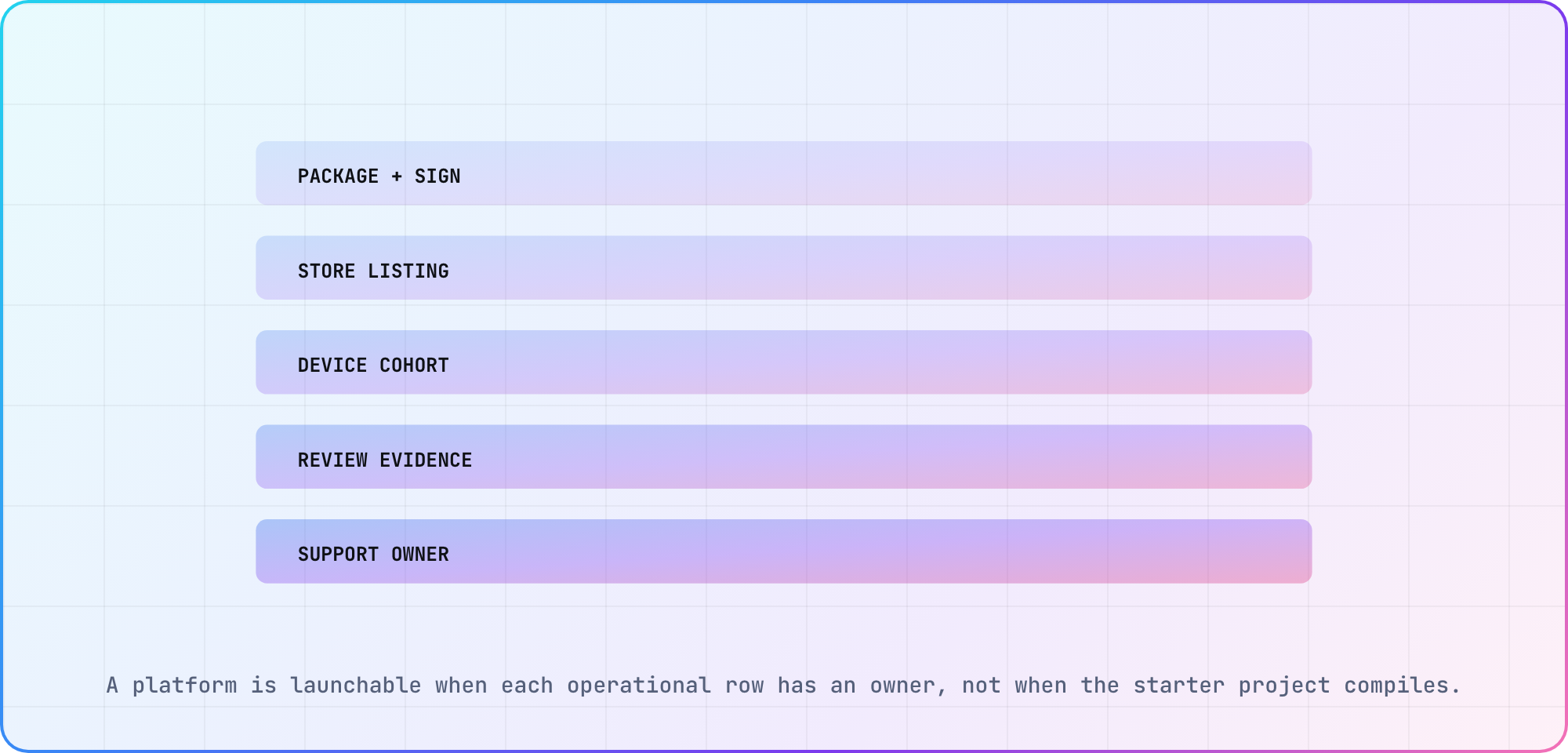
A platform is launchable when each operational row has an owner, not when the starter project compiles.
Choose with an ownership scorecard
Score each platform against your known audience, team skills, existing code, playback risk, store workload and support burden. Then put names beside package signing, store metadata, device lab coverage and post-release incidents. A platform with no owner is a business wish, not a launch plan.
I'd choose the first platform that combines reachable audience with a team that can carry it through support. Use the first release to harden backend contracts and analytics, then add the next runtime deliberately. Our device database has a platform-level row for each of the three, which is a quick read before you name the device cohorts yourself.
Frequently asked
Which platform is easiest for an Android team?
Fire OS devices may provide the most familiar starting point because the stack is Android-derived. Check the exact Fire TV targets first, including whether Vega devices are required. Familiar source code doesn't remove Amazon-specific media, purchasing, launcher, store and hardware testing work.
Can one codebase cover all three platforms?
You can share APIs, catalog models, analytics contracts and design tokens. Roku, Fire TV and tvOS still have different runtimes, UI behavior, players, packages and stores. Plan platform shells and owners explicitly. "One codebase" is useful only after the sharing boundary is named.
Does Roku require BrightScript?
Roku's application model uses BrightScript and SceneGraph. A service can reuse backend and product logic across platforms, but the Roku client is its own implementation. Treat Roku engineering, device tests and certification as a distinct track rather than a packaging step for another app.
Is Fire TV the same as Android TV?
Fire OS is Android-derived, so many Android concepts and tools carry over, but Amazon owns the devices, services and store. Newer Vega targets add another runtime consideration. Verify the model and operating system before assuming an Android TV artifact or dependency behaves unchanged.
Can the Apple TV simulator replace hardware testing?
No. The simulator is useful for layout, focus flow and fast iteration. A physical Apple TV is needed for remote behavior, media playback, network conditions, lifecycle and performance evidence. Keep simulator and hardware results labeled separately so a green fast loop doesn't become a false release claim.
What should determine the first platform launch?
Use your reachable audience, existing team, player risk, store work and support capacity. Public market size is context rather than the answer. The strongest first platform is one you can release and support well while producing reusable evidence for the next runtime on the roadmap.
Keep reading
Remote Smart TV Testing Without a Local Device Lab
Compare remote smart TV testing by exact hardware coverage, interaction depth, private-network access and evidence capture, then keep a small local smoke kit.
Samsung Tizen TV Test Automation: Limits and Workarounds
Automate Samsung TV build, signing, install and evidence capture while keeping device focus and playback verdicts outside unsupported official UI automation.