Which TV Platforms Should You Launch On First?
Choose the first TV platforms with a weighted scorecard for audience, code reuse, playback risk, certification work and support cost for a practical roadmap.
The first TV platform should be the one that proves your service with the least misleading success. A huge audience is attractive, but a quick Android TV port can still be the better beachhead if it validates playback, entitlement and living-room navigation before the team learns three unfamiliar runtimes at once.
That's why a TV platform launch strategy needs your audience and operating constraints. Public market-share reports measure different things. Pixalate's device share uses programmatic advertising activity, while Ofcom's December 2024 connected-TV platform report covers active devices in the UK. Useful inputs, different denominators.
Build the audience map first
Pull account, playback and support data by country and current device where you have it. Add a clearly labeled external estimate where you don't. A US-first ad-supported service can reach a different answer from a subscription product launching in the UK.
| Factor | Weight example | Evidence |
|---|---|---|
| Reachable audience in launch countries | 30 | First-party usage plus named market source |
| Existing code and team fit | 20 | Current mobile, web and player stack |
| Playback and DRM risk | 20 | Required formats, ads and entitlements |
| Store and certification effort | 15 | Current platform documentation |
| Ongoing support cost | 10 | Device generations and release history |
| Strategic distribution value | 5 | Signed partner or placement commitment |
The weights are a starting model, not an industry rule. Change them in front of the decision makers. If a platform partnership is the reason for launch, don't hide it inside a fake technical score.
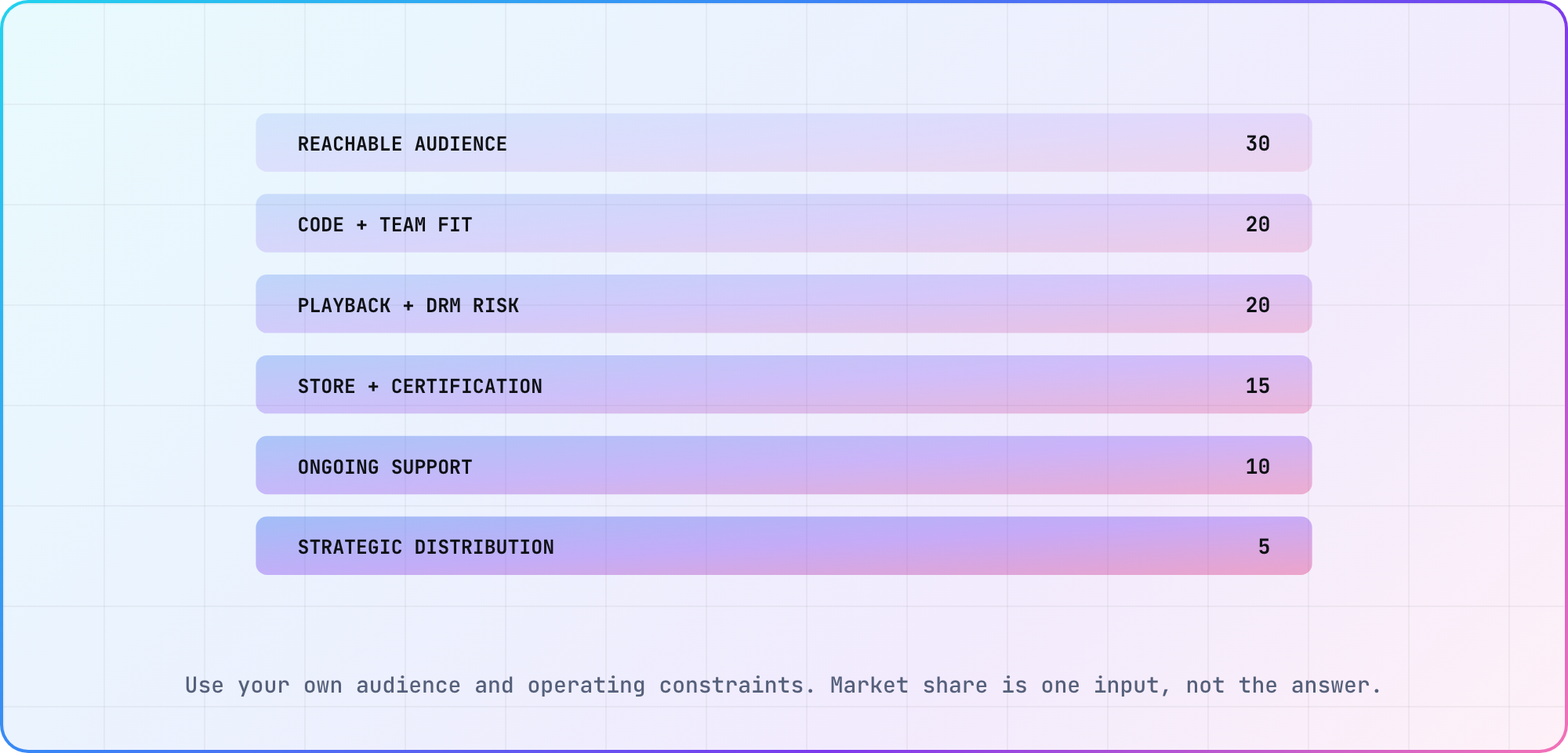
Illustrative scorecard. Fill it with the service's own audience and operating data.
Group platforms by runtime and release work
Android TV and Fire OS can share Android skills and parts of a player stack, though store rules and device behavior still differ. Apple TV has a focused hardware family and Apple's native stack. Samsung Tizen and LG webOS use web technologies with separate platform APIs, model generations and seller workflows. Roku uses BrightScript and SceneGraph.
This grouping helps sequence learning. It doesn't promise one codebase. The native versus cross-platform guide shows where product logic can travel and where focus, playback and packaging usually stay platform-owned.
Create a one-page target card for each candidate:
- countries and reachable viewers
- runtime, language and player choice
- DRM, ads, live and accessibility requirements
- store account, review path and launch lead time
- test hardware and automation coverage
- owning engineer and on-call plan
A card with unknowns is useful. It tells you where a short technical spike has more value than another planning meeting.
Pick a beachhead and a second platform
The beachhead should prove the riskiest shared product assumptions without consuming the whole roadmap. If the team already ships Android mobile video, Android TV may reuse media, networking and observability work. If the audience is concentrated on Roku, learning BrightScript may be worth the earlier cost. If an Apple ecosystem partnership drives the launch, tvOS can be the obvious first answer.
Choose the second platform at the same time. Its job is to test whether your architecture has honest sharing boundaries. A second Android-family target may validate reuse; a web-TV or Roku target exposes assumptions that were accidentally native.
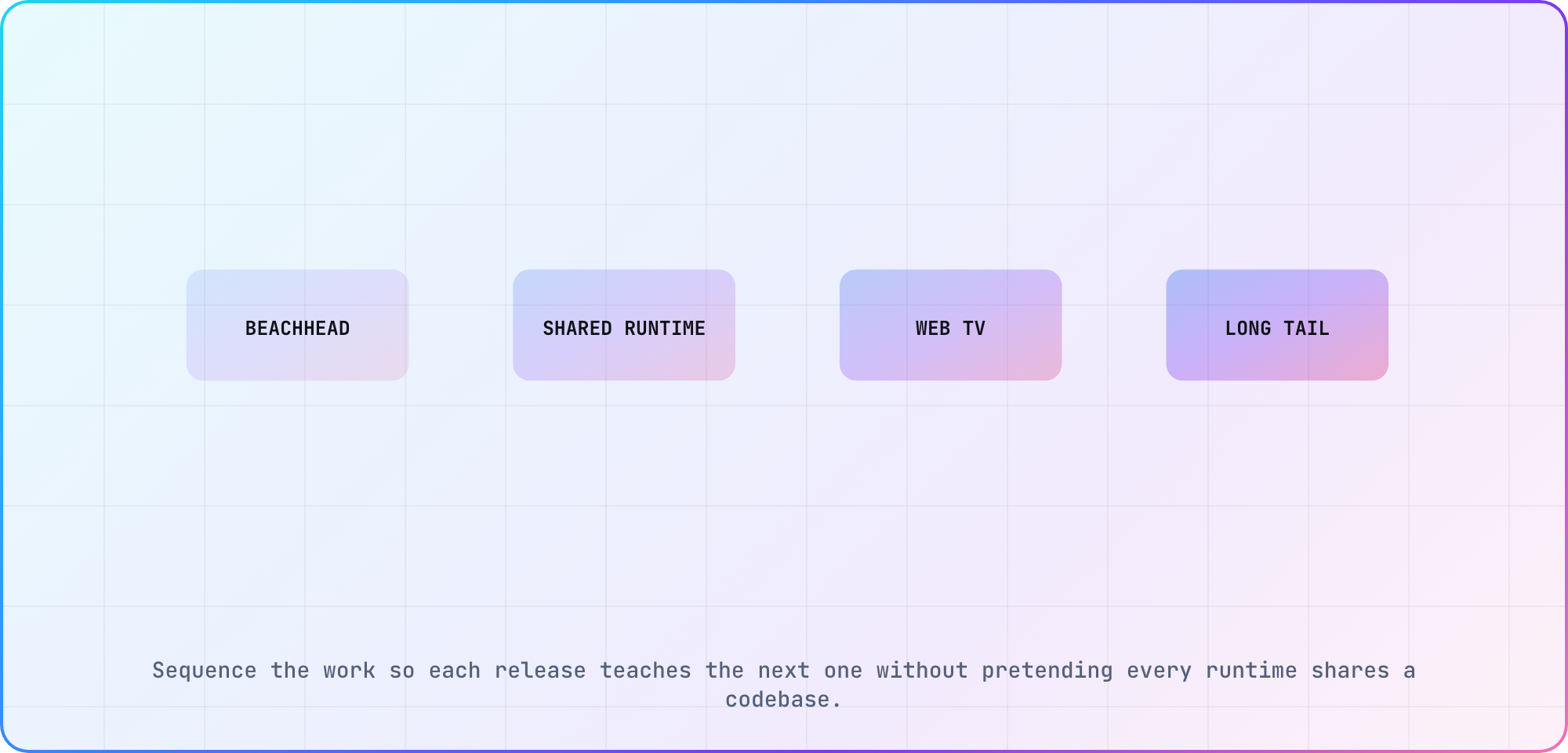
Illustrative sequence. The runtime labels should follow the platforms that win the service's scorecard.
Budget certification and support with development
A feature-complete build can still be weeks from a dependable launch when store assets, reviewer accounts, device testing and fixes start late. Give release work an owner during development.
Support cost continues after approval. Count OS generations, model groups, player differences and the time required to reproduce customer issues. A small audience on a difficult runtime may still be valuable, but the scorecard should show the trade rather than bury it.
My recommendation is to launch one beachhead, then one adjacent platform, then expand by measured audience and support yield. Starting five builds together delays learning and makes every architecture decision theoretical. If you do nothing, the roadmap will default to the loudest market-share chart or the framework the team already knows.
Frequently asked
Which TV platform should an OTT service launch first?
Choose the platform that scores highest for your reachable audience, team fit, playback requirements, store work and support cost. There isn't a universal first choice. Use first-party country and device data where possible, then label external market estimates by source and denominator before assigning a roadmap priority.
Should market share decide the launch order?
Market share deserves a strong weight, but it shouldn't decide alone. Reports may measure device sales, active households, viewing or advertising activity. Combine the measure that fits your business with code reuse, DRM, certification and support cost. Write the denominator beside every percentage so the team compares like with like.
Can Android TV and Fire TV share one app?
They can share substantial Android code on Fire OS targets, but device features, stores, services and certification still differ. Amazon also has Vega OS targets that use another package and toolchain. Keep a target inventory and verify the exact runtime before treating Fire TV as an Android extension.
When should Roku move up the roadmap?
Move Roku up when audience concentration, a distribution agreement or strategic reach outweighs the cost of a separate BrightScript and SceneGraph runtime. Prove the device, packaging, focus and playback loop early. A short spike with a real Roku gives better cost evidence than a framework comparison alone.
How many TV platforms should launch at once?
For a new team, one beachhead and one planned follower usually produce clearer learning than several simultaneous builds. A mature organization with platform owners can run more in parallel. Count release and support capacity, not developer headcount alone, because every store and device family creates continuing work.
What data should we collect after the first launch?
Track activation, playback success, startup time, crashes, support volume, release effort and device-specific defects by app version and model. Compare the results with the scorecard assumptions. Use that evidence to reweight the second and third platforms instead of treating the original roadmap as a permanent commitment.
Keep reading
Remote Smart TV Testing Without a Local Device Lab
Compare remote smart TV testing by exact hardware coverage, interaction depth, private-network access and evidence capture, then keep a small local smoke kit.
Samsung Tizen TV Test Automation: Limits and Workarounds
Automate Samsung TV build, signing, install and evidence capture while keeping device focus and playback verdicts outside unsupported official UI automation.