How Much Does It Cost to Build a CTV App?
Estimate CTV app cost from product journeys, runtime tracks, video complexity, store releases, device coverage and ongoing support instead of a sticker price.
A credible CTV app estimate can't start with "one television app." Roku, tvOS, Android-family devices and web televisions don't share one runtime or store. Playback can add DRM, ads, live latency and entitlement work before a designer moves the first focus ring.
The cost to build a CTV app is the sum of named work packages plus uncertainty. A sticker price without a platform list, playback path, device cohort and support term is sales copy. Build the estimate from inputs your team can inspect.
Define the product journey first
List the journeys a viewer can complete: browse, search, sign in, subscribe, play, seek, switch audio or captions, resume and recover from errors. Add profiles, parental controls, live guides or commerce only when they are truly in scope. Every journey creates UI, analytics, backend and test work.
| Cost driver | Low-complexity case | Higher-complexity case |
|---|---|---|
| Platforms | One runtime and store | Roku, native, Android and web tracks |
| Playback | Clear VOD | DRM, ads, live, multiple codecs |
| Accounts | Code-based sign-in | Profiles, subscriptions and parental controls |
| Discovery | Browse and search | Recommendations, deep links and home surfaces |
| Devices | Small current cohort | Old firmware and low-memory long tail |
| Release | One store owner | Multiple certifications and staged rollouts |
| Support | Launch handoff | Monitoring, triage and regular platform updates |
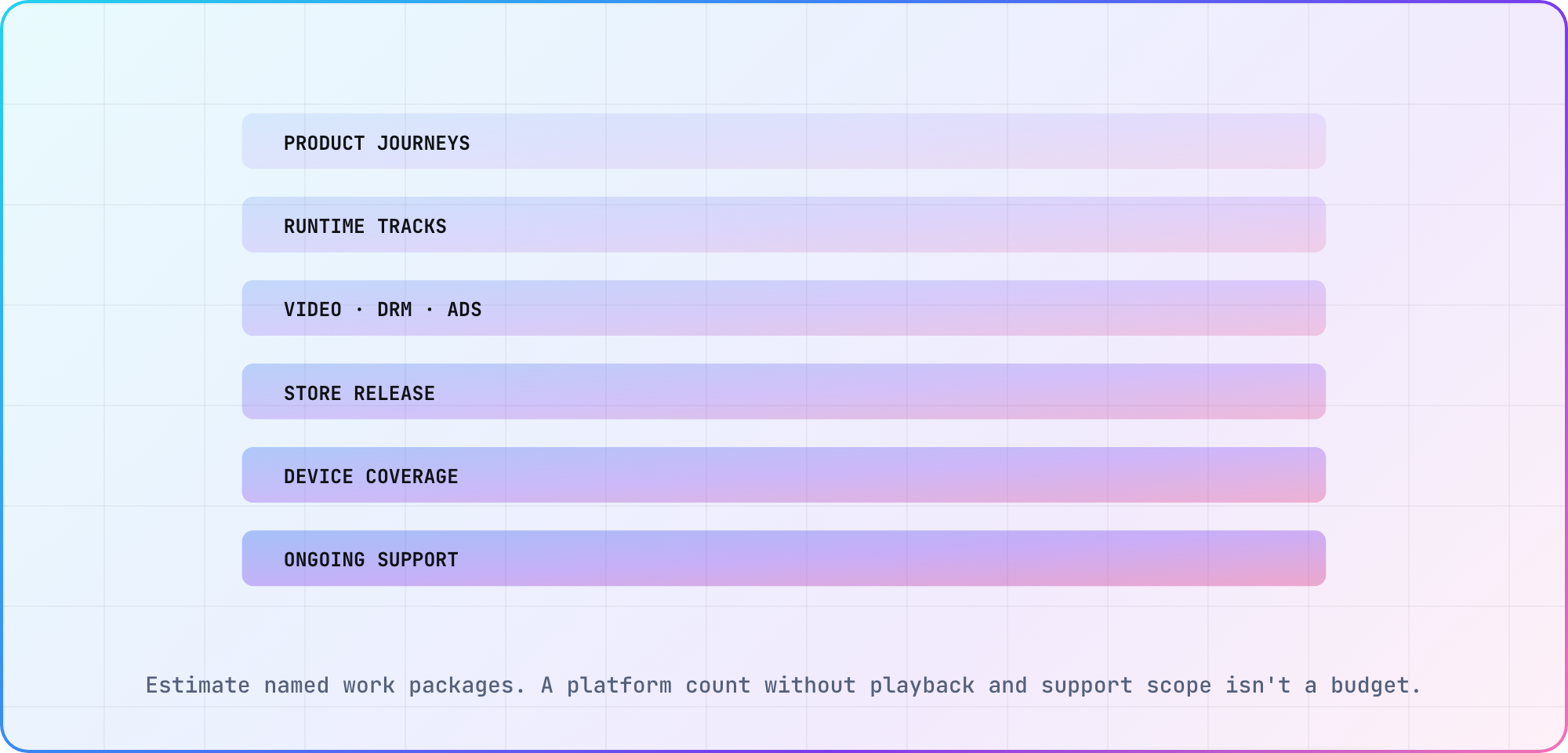
Estimate named work packages. A platform count without playback and support scope isn't a budget.
Price runtime tracks separately
Roku's BrightScript and SceneGraph workflow is a different implementation from Apple's tvOS track. Android TV and Fire OS may share useful code, but Amazon-specific services and device requirements remain. Samsung and LG web apps still have distinct packages, APIs and stores.
Estimate a shared product layer once, then estimate each platform adapter, player integration, package and release path. Add an integration line for every native escape or vendor service. This makes code reuse visible without assuming it removes platform work.
Treat playback as its own estimate
Ask for the actual media matrix: HLS or DASH, codecs, DRM systems, server-side or client-side ads, live or VOD, captions, audio tracks and expected startup behavior. Confirm which pieces already exist in backend services and which must be built into the client.
I'd spike the riskiest playback path on the weakest target device before fixing the range. Ten days spent proving the player can retire more uncertainty than ten pages of estimation assumptions. Use the video-start benchmark method to define what that proof measures.
Add device and store evidence
Each supported cohort needs install, launch, remote, playback, memory and lifecycle checks. Keep those cohorts named in the TV platform reference. Each store needs metadata, privacy answers, screenshots, signed artifacts and reviewer evidence. Android's current TV quality criteria show why "the APK works" is only one line in the release scope.
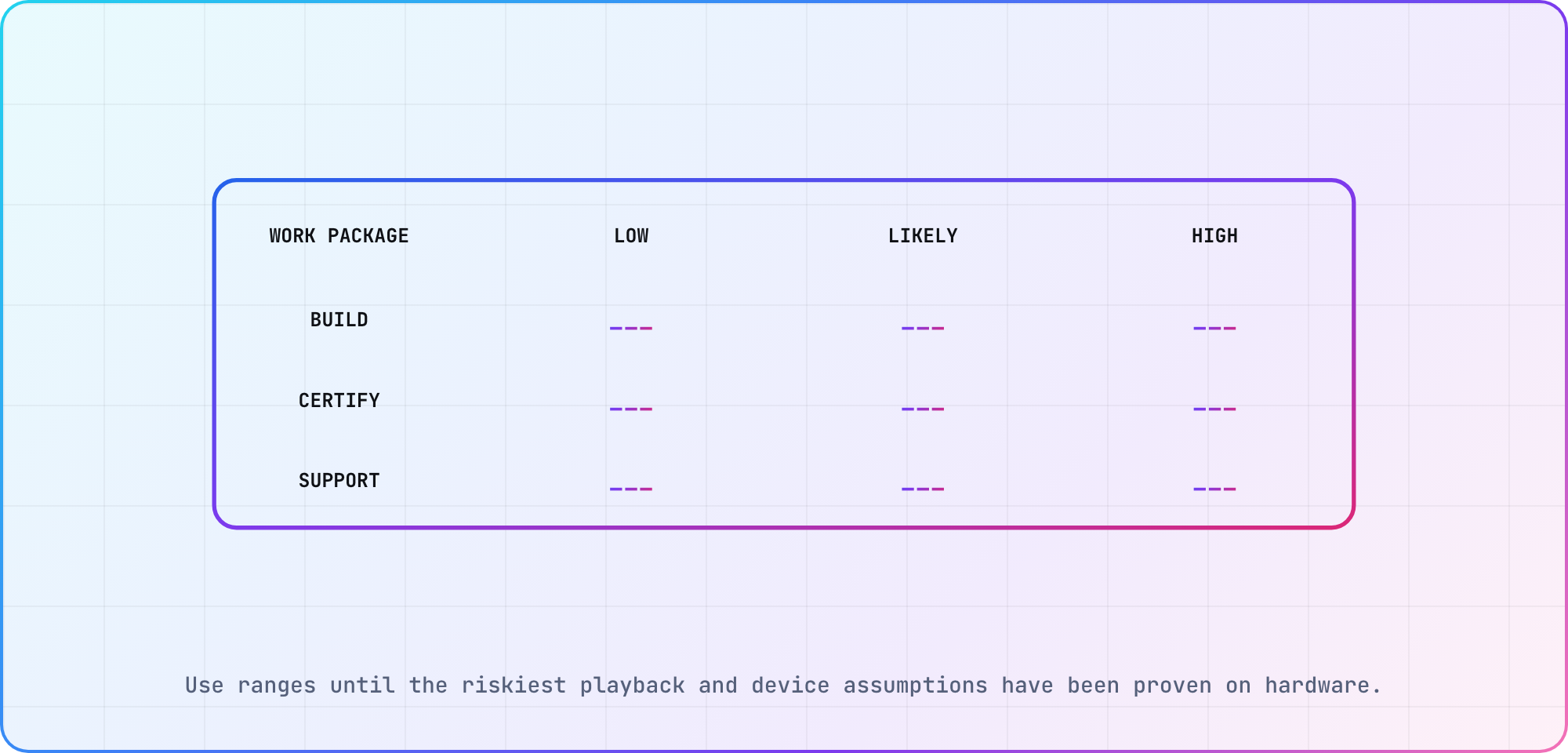
Use ranges until the riskiest playback and device assumptions have been proven on hardware.
Build a low, likely and high range for each work package. Keep risk reserve visible rather than spreading it invisibly across tasks. When a spike resolves an assumption, narrow the affected row and leave the others alone.
Include the cost after launch
Budget dependency and OS updates, store changes, new device cohorts, incident triage, analytics maintenance and release ownership. A low build quote can become an expensive product when nobody owns certification changes or a black-screen cohort six months later.
The CTV release-readiness checklist provides a practical list of recurring work. Convert each applicable gate into build, test or operating ownership. That creates a range a buyer can challenge and a delivery team can defend.
Frequently asked
What is a realistic budget for a CTV app?
There isn't a responsible universal number. The range changes with runtime count, playback, accounts, device coverage, stores and support. Ask for an estimate broken into those work packages, with assumptions and a low, likely and high case. That structure is more useful than an unexplained market range.
Why does adding one TV platform cost so much?
A platform can add a runtime, UI and focus behavior, player integration, package, signing, store listing, certification, devices and ongoing support. Shared services reduce some work, but the new release track still needs an owner and evidence. Price the incremental track instead of multiplying one app screen count.
Can React Native reduce the total cost?
It can share product logic across supported native TV targets, especially Apple TV, Android TV and Amazon's Vega OS, whose SDK uses React Native. It doesn't remove platform playback, focus, lifecycle, store and device work, and it doesn't produce a Roku application. Estimate the shared layer and each platform-owned layer separately before claiming savings.
Should design be estimated by screen count?
Screen count is a weak television measure. A browse screen with many focus states, virtualized rows and restoration rules may cost more than several static settings screens. Estimate remote journeys, error states and transitions. Include ten-foot readability and accessibility checks on real television hardware.
What usually creates the biggest estimate risk?
Unknown playback requirements, unsupported dependencies, old-device performance, account and purchase flows, and unclear store ownership create large ranges. Resolve the riskiest item with a short hardware spike. Then update that row instead of pretending the whole project became certain after a prototype launched.
What ongoing costs should be included?
Include platform and dependency upgrades, certification changes, device refresh, monitoring, incident triage, analytics, store metadata and release management. Name the support term and response expectations. A build-only estimate is fine when labeled clearly; it shouldn't be presented as the cost of operating the application.
Keep reading
Remote Smart TV Testing Without a Local Device Lab
Compare remote smart TV testing by exact hardware coverage, interaction depth, private-network access and evidence capture, then keep a small local smoke kit.
Samsung Tizen TV Test Automation: Limits and Workarounds
Automate Samsung TV build, signing, install and evidence capture while keeping device focus and playback verdicts outside unsupported official UI automation.